



The Fraud of Urgency: Why Everything Feels Like a Fire—And Nothing Gets Solved
By Ryan Gartrell, Business Consultant | Writer | Lean AI® Expert
In the modern workplace, fire drills are the business model.
One meeting leads to another, flagged as high priority. A client email becomes a crisis. A Slack ping breaks momentum. Deadlines get moved up “urgently.” Everything is on fire—and no one remembers how the fire started.
If you ask most teams what they did last month, they might list dozens of things. But ask them what they actually solved? The list gets short. Suspiciously short.
This is not accidental. It is designed.
Urgency has become the organizing principle of American business—not because it’s effective, but because it’s addictive.
And it’s killing strategic thinking.
The Culture of Panic
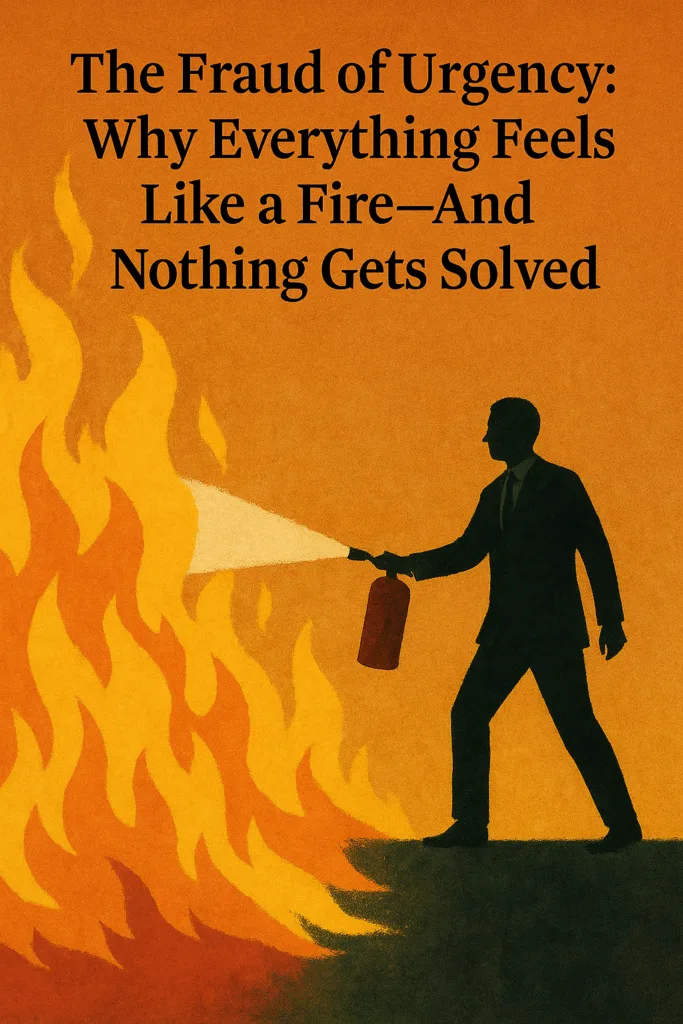
Urgency offers a high. It creates movement, adrenaline, visible energy. Leaders get to look decisive. Teams get to feel heroic. There are quick wins, fast check-ins, all-hands announcements, executive Slack blasts.
It feels like leadership. It feels like momentum.
But it is, more often than not, manufactured chaos. A substitute for clarity. A culture of panic.
In my work as a business consultant, I’ve seen companies hit $20M in revenue with no clear SOPs, no predictable cadence, no long-term roadmap. Why? Because their entire organization is a reaction machine.
The result? Burnout, confusion, turnover, and decisions made for optics instead of outcomes.
Why Urgency Feels So Good (and Works So Poorly)
Here’s the psychological trap: urgency gives us a dopamine hit. It makes us feel useful. We clear an inbox, respond to an issue, put out a fire—and it feels like productivity.
It’s not.
Most urgent requests are proxies. They mask deeper issues:
- The rushed sales campaign that hides poor forecasting.
- The urgent redesign that masks bad messaging.
- The surprise customer churn that reveals a broken onboarding process.
Urgency is rarely about what’s most important. It’s about what’s most visible.
Lean AI® Insight: Diagnose, Don’t React
At Ryan Gartrell Consulting, we work with companies trapped in this urgency cycle. The solution isn’t more meetings or tighter deadlines.
It’s diagnostics.
Our Lean AI® methodology slows the chaos to identify patterns. It reveals where teams are leaking time, duplicating work, and chasing symptoms.
Once identified, we restructure workflows to prioritize outcomes over optics. Instead of triage, we build systems. Instead of task churning, we focus on the root cause.
How to Spot a Company Addicted to Urgency
If your organization exhibits any of the following, you might be leading through adrenaline, not alignment:
- Every project is “last minute.”
- Weekly priorities change… weekly.
- Meetings feel performative.
- No one knows who owns what.
- Everyone is exhausted, but nothing feels finished.
These aren’t execution problems. They’re operational ones.
The Leadership Illusion
Many leaders confuse constant presence with effective direction. They jump into threads. They reapprove decisions. They signal urgency with “Just checking in…” or “This is a big one.”
But great leadership isn’t loud. It’s structured.
The best teams I’ve worked with have:
- Pre-scoped timelines
- Defined escalation protocols
- Transparent responsibilities
- A culture of asynchronous problem solving
Urgency is rare. By design.
Conclusion: Firefighting Is Not a Strategy
If everything is urgent, nothing is.
And if your business can only operate in crisis mode, it’s not operating. It’s reacting.
At Ryan Gartrell Consulting, we help businesses build the muscle for calm execution. We install structure. We kill fake urgency. We empower teams to think, not just respond.
True growth doesn’t look like chaos. It looks like control.
It’s time to stop performing stress. And start solving problems.

