



I paid Newegg. The package went to a man named Paul Garcia in Kansas. Somehow, this became my problem.

Building a dream computer is an exercise in optimism.
You spend weeks comparing processors, motherboards, cooling systems, graphics cards, power supplies, cases, fans, cables, and enough RGB lighting to make a small casino jealous. You convince yourself that every purchase is rational. Necessary, even. This is not merely a computer. It is a carefully engineered productivity machine.
A workstation.
A creative command center.
A tax-deductible monument to poor impulse control.
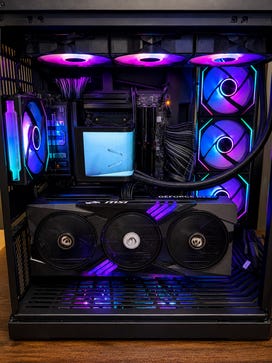
Mine was finally finished, or so I thought, which was great because the computer I was replacing had been running at over 200 degrees and crying out for a lifeline for months. No duct tape or baling wire was going to fix the Grey Ghost as I had been calling her.
The new computer was fast, beautiful, quiet, and capable of running four monitors, a television, ninety-seven browser tabs, Photoshop, WordPress, email, cloud storage, and whatever other digital nonsense I insist on keeping open at the same time.
There was only one problem.
It was using nearly 80 percent of its memory during a normal workday.
That is not catastrophic, but it is the computer equivalent of breathing heavily while carrying groceries from the car. It can do the job, but you know another flight of stairs is going to cause trouble.
Fortunately, I had planned ahead.
I had installed 32 gigabytes of Patriot Viper Venom DDR5 memory and ordered an identical second kit from Newegg. Same manufacturer. Same model number. Same speed. Same capacity. Same timings.
Computer memory is not an area where you want to get creative.
You cannot simply throw random sticks into the motherboard like leftover batteries in a kitchen drawer. Mixing memory can cause instability, crashes, boot failures, and hours spent staring at a BIOS screen while questioning every decision that led you there.
The additional kit cost me $414.
Not cheap, but this was the final component. The last piece of the machine I had spent months planning and assembling.
The order page said it would arrive in five to seven days.
Then the tracking information began its world tour.
The package was apparently coming from China, something that had not been particularly obvious when I placed the order. It moved from shipper to airport, airport to transit, transit to another airport, then customs, then another shipper, another airport, another transit facility, and possibly a brief spiritual retreat somewhere over the Pacific.
The tracking never really said where the package was.
It read more like the itinerary of a fugitive.
Shipper.
In transit.
Airport.
Another airport.
Customs.
Transit.
A different shipper.
Another airport.
Delivered.
Twenty-one days after ordering memory that was supposed to arrive in five to seven days, the tracking suddenly declared the package delivered.
There was just one minor issue.
It had not been delivered to me.
I live in Florida.
The package was reportedly delivered to someone named Paul Garcia in Kansas.
I am not Paul Garcia.
I have never been Paul Garcia.
To the best of my knowledge, I have never even been mistaken for Paul Garcia.
Yet somewhere in Kansas, a man with a completely different name at a completely different address had apparently received my $414 computer memory.
Or maybe he had not.
Nobody seemed entirely sure.
I contacted Newegg, because I bought the memory through Newegg. I paid Newegg. The order appeared in my Newegg account. Newegg took the money. Newegg sent the confirmation. Newegg provided the tracking.
That seemed like a reasonable place to begin.
This is where I learned that I had not really purchased the memory from Newegg.
I had purchased it from a company called Doren Tech.
This was news to me.
I did not visit Doren Tech.
I did not create a Doren Tech account.
I did not browse Doren Tech’s website late at night while pretending that $414 for computer memory was perfectly normal.
I went to Newegg.
Newegg, however, explained that because the product had been sold by a marketplace reseller, I would need to work with the reseller.
This is one of the great innovations of modern commerce.
A company creates the store, attracts the customer, processes the payment, displays the product, collects the money, and lends its reputation to the transaction. Then, when something goes wrong, it steps backward, raises both hands, and announces that it was merely hosting the gathering.
Apparently, Newegg was not the retailer.
Newegg was the room where the retailer happened.
I was told I needed to contact Doren Tech and give them five to seven days to respond.
Five to seven days.
The same phrase that had once described the entire delivery window was now merely the waiting period required for someone to acknowledge that my package had been sent to a stranger 1,300 miles away.
By this point, I had already waited three weeks.
Now I was being asked to conduct an investigation into Newegg’s reseller, locate the missing shipment, document the delivery discrepancy, communicate with the seller, and patiently await a response.
I was no longer a customer.
I was unpaid logistics staff.
Accidents happen. Packages get mislabeled. Addresses are entered incorrectly. Drivers make mistakes. Systems fail. I understand all of that.
What matters is what happens next.
A good company says, “We see the problem. We will take care of it.”
A bad system says, “You will need to contact someone else.”
Doren Tech eventually responded and offered to resend the memory.
That was good news.
They even said they would expedite the replacement from a warehouse in the United States.
Perfect.
Problem solved.
Except it was not.
Without another conversation, Doren Tech canceled the replacement and refunded the purchase.
On paper, that may sound reasonable.
I paid $414. They returned $414.
Everybody walks away even.
Except we did not.
Because while my original memory was touring international airports and being delivered to the mysterious Mr. Garcia, the price of computer memory had climbed dramatically.
The same kit that cost me $414 was now listed in some places for more than $600.
That is not a minor increase.
That is not inflation.
That is memory deciding it wants to attend private school.
The timing could hardly have been worse. The explosive growth of artificial intelligence and data centers has increased demand for memory components, and consumers are once again discovering that technological progress often means paying more money for the same rectangle of silicon you could afford last month.
So Doren Tech refunded the original purchase, Newegg wiped its hands of the transaction, and I was left trying to locate the exact memory kit on my own.
Not similar memory.
Not memory from the same company.
Not memory with nearly the same model number.
The exact kit.
Same speed. Same latency. Same configuration. Same model.
Retail listings make this much harder than it should be.
One listing says DDR5-6000 but shows a different latency. Another uses the correct product photograph but lists DDR5-5600. Another appears to have the same model number while displaying contradictory specifications. Some listings are RGB. Some are not. Some contain two sticks. Some contain one. Some appear to have been written by a person who once overheard a conversation about computers in an airport lounge.
At one point, I found several listings using nearly identical descriptions with prices ranging from about $400 to more than $800.
For memory.
Not a graphics card.
Not a processor.
Memory.
This is how a simple missing shipment becomes a small consumer nightmare.
The original mistake was probably mundane. Someone entered the wrong label. A database associated the order with the wrong customer. A shipping partner scanned the wrong package.
The real failure came afterward.
The customer was left responsible for navigating the layers of companies involved in a transaction that had appeared, at the time of purchase, to be a transaction with Newegg.
That is the fundamental problem with marketplace retail.
The brand at the top receives the trust.
The reseller receives the order.
The shipping company receives the package.
And when the transaction fails, the customer receives the homework.
Newegg benefits from looking like a retailer when the sale is made and behaves like a bulletin board when something goes wrong.
That is a wonderful arrangement for Newegg.
It is considerably less wonderful for the person whose $414 purchase was delivered to Paul Garcia in Kansas.
I do not expect every company to control every package from warehouse shelf to front porch. That would be unreasonable.
I do expect the company that took my money to own the resolution.
Newegg could have sourced the identical memory from another seller and honored the original price. It could have issued store credit covering the difference. It could have assigned one representative to manage the seller dispute. It could have done almost anything beyond telling me to contact a company I had never heard of and wait another week.
Instead, the system produced the most technically defensible result and the worst practical one.
I received my money back.
I did not receive what I purchased.
And replacing it may now cost me several hundred dollars more.
That is how you get fucked by the system without anyone technically stealing from you.
Every company can point to a policy.
Every representative can say the refund was processed.
Every marketplace seller can close the ticket.
Every spreadsheet balances.
Only the customer is left short.
My dream computer is still running. It is still beautiful. It is still using nearly 80 percent of its memory while I write this.
And somewhere in Kansas, Paul Garcia may be enjoying 32 gigabytes of Patriot Viper Venom DDR5-6000 RAM.
Paul, if you are reading this, I hope your computer is running beautifully.
Mine would be too, if Newegg had remembered which one of us paid for it.
Ryan Gartrell writes about business, technology, operations, bad systems, and the small absurdities that reveal how companies actually work. No Paul Garcias in Kansas were harmed in the writing of this article.
He is the founder of The RYAN Method™ and the Lean AI Advantage® framework, and advises businesses on operations, efficiency, growth, and the occasional corporate mess that should never have become the customer’s problem.
